
Decisions are shaped by what matters to the people they affect.
On this page
Download the Framework
About the Framework
The Partnering in Healthcare Framework helps health services include consumer knowledge and expertise to shape decisions at every level.
Use it to:
- reflect on your current approach to partnering
- identify strengths and examples of good practice
- understand how consumers experience partnering with your service
- recognise gaps or barriers that may affect participation or influence
- prioritise actions for improvement
- monitor progress over time
- contribute to shared learning across the health system.
The Framework is not a checklist or a prescribed set of activities. It helps services understand meaningful partnering, review current practice and identify improvements.
What partnering in healthcare means
People who use health services, support someone through care or live with a health condition have expertise the health system cannot generate on its own.
Partnering matters in individual care, service improvement, organisational governance and system reform.
There is no single way to partner. Good practice relies on reflection, learning and improvement.
Partnering is how we care, improve and lead together.
Why partnering is important
Partnering with consumers is a core component of best practice clinical governance, and when done meaningfully and genuinely, can improve care outcomes and reduce avoidable harm.
Consumers can help the healthcare system understand:
- how services are experienced
- barriers to access
- what matters most to patients, families and carers
- where processes work well
- where unintended consequences occur.
Bringing that knowledge together with clinical and professional expertise leads to safer care, services that fit people’s lives and stronger trust in the system.
What consumers can expect
Meaningful partnering happens when people with relevant lived experience are involved early enough to influence a decision, can contribute safely and are valued for what they bring, are accurately understood, and can see how their expertise shaped the outcome.
Consumers expect to:
- know what decision is being made and why they’ve been invited to participate
- feel, welcome, safe and have their experience acknowledged
- get information in ways that work for them
- understand how their contribution will be used
- see what happened because they participated.
Health services are responsible for creating the conditions for consumers to participate safely, meaningfully and with influence. Consumers choose how and to what extent they take part.
What good partnering looks like
Meaningful partnering welcomes and respects people, values their expertise and enables them to influence decisions.
Five conditions make this possible:
-
Person-centred
-
Safe and inclusive
The people involved reflect those affected, and can take part safely.
-
Clear and transparent
People know why they are involved, their role and how much influence they have.
-
Shared understanding
Knowledge flows both ways, and consumer input reaches decision-makers in their own words.
-
Shared decision-making
People can see how their contribution shaped the decision.
What health services need to do
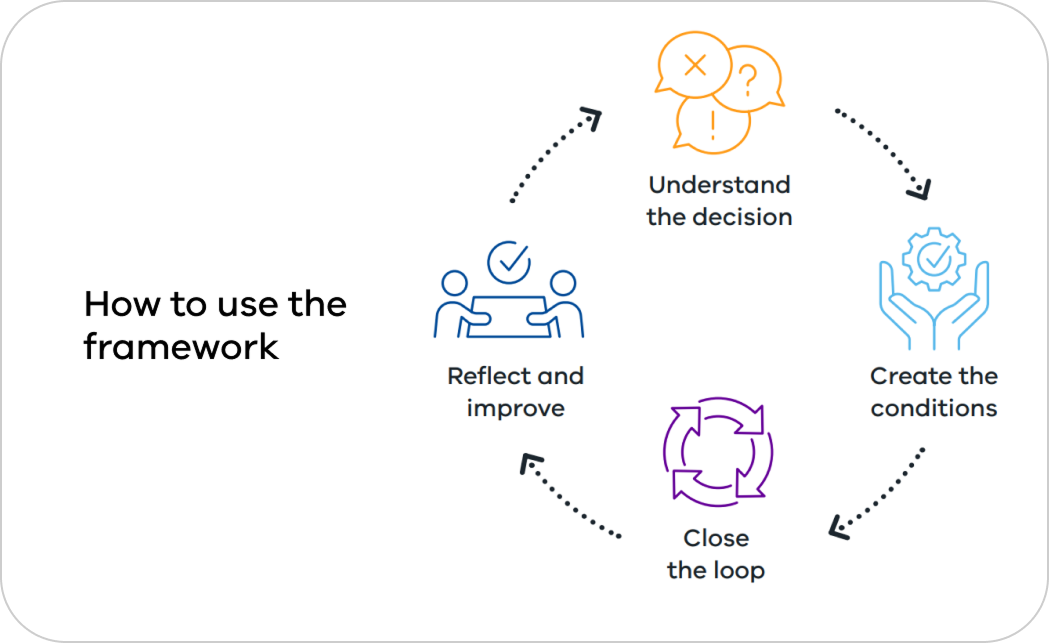
Use these four actions to plan, review and improve partnering.
-
 Understand the decision
Be clear on what’s being decided, who it affects and how much influence is possible. Start early, while choices are still open.
-
 Create the conditions
Put the five conditions in place, and check that consumers experience them.
-
 Close the loop
Share what was heard, what changed, why decisions were made and what happens next. If nothing changed, explain why.
-
 Reflect and improve
Learn from what worked and what didn’t.
Alignment with existing requirements
Victorian health services are required to partner with consumers under the Health Services Act 1988, which requires public health service boards to appoint a Community Advisory Committee, the Victorian Clinical Governance Framework, where partnering with consumers is one of five domains, and Standard 2 of the National Safety and Quality Health Service (NSQHS) Standards.
The Framework recognises Aboriginal self-determination and Victoria’s Statewide Treaty, including the roles of the Assembly of Gellung Warl, Aboriginal Community Controlled Organisations and Traditional Owners. It sits alongside these commitments and does not replace them.
Statement of Intent
Health services no longer need to submit a Statement of Intent to SCV, and it is no longer part of the framework.
Partnering is now covered by other frameworks and standards that already have reporting requirements. Instead, we encourage you to use the Framework as part of an ongoing cycle of improvement.
Contact us
We encourage health services to work collaboratively with their Local Health Service Network (LHSN) to consider how the Framework can support your partnering practices.
For any enquiries, feedback or support, contact us at partnering@safercare.vic.gov.au.