All Things Neonates
View more View less
January 2026
This Clinical Conversation covered the essentials of neonatal care, including feeding and growth, neonatal observations, and the immunisation schedule in the first months of life. Common neonatal complications such as jaundice, hypothermia, hypoglycaemia, and skin conditions were explored. Dr Tristan Harding explained the neonatal sepsis calculator with case examples.


Clinical Conversation: Movements really do matter
View more View less
Hear Dr Billie Bradford highlight fetal movement awareness. This is one of the Stillbirth Centre of Research Excellence’s key strategies to reduce stillbirths. Dr Billie presents the updated clinical practice guideline for management of decreased fetal movements, highlighting key takeaways for pregnant women and clinicians.
Congenital syphilis
View more View less
December 2022
Hear updates on the concerning epidemiology of congenital syphilis in Victoria; the patient themes identified, and the important elements of pregnancy diagnostics. Learn about management in pregnancy, including recommended treatments and new guidelines, and the role of the Victorian Investigation of Complex STIs (VICS) team and near misses considered.
Dhelkaya Health - learnings from a new maternity model of care
View more View less
June 2023
Dhelkaya Health (Castlemaine) offers low risk pregnant women access to local maternity care in a rural setting. In May 2021 our maternity service re-commenced under a new continuity of care model following a 12-month suspension of the service. We are proud of this achievement when it is a common occurrence for small services to close their maternity services. Twelve months after the re-instatement of Dhelkaya Health’s maternity service La Trobe University was engaged to undertake an evaluation of the new model of care. The evaluation was conducted with three areas of focus: an exploration of key stakeholder views, an exploration of maternity consumers views, and an audit of clinical outcomes. From these three areas eighteen recommendations were made. Listen to our journey and the recommendations made by the evaluation.
Extreme prematurity
View more View less
May 2022
Our webinar provides background to the development of SCV's Extreme prematurity guidance and highlights the components and resources available including management flowcharts and parent information sheets.
A multidisciplinary panel of perinatal clinicians discusses the clinical, logistical and ethical challenges in caring for women and babies at 22-25 weeks’ gestation, and proposes strategies to ensure consistency in practice across all perinatal settings statewide to optimise outcomes.
Interventions for vaccine preventable infections in pregnancy
View more View less
August 2022
This webinar explores Interventions for vaccine preventable infections (influenza, pertussis and hepatitis B) in pregnancy, presents research findings from three studies, and discusses opportunities for improvement in delivery of influenza, pertussis, and hepatitis B vaccinations and care to women and their infants to prevent infection during and post pregnancy in Victoria.
Perineal Protection
View more View less
April 2022
This webinar provides an overview of the SCV Perineal Protection Project highlighting the success of consumer engagement. We also spotlight the ACSQHC Third and Fourth Degree Perineal Tears Clinical Care Standard and provide an update on the outcomes of the SCV Better Births for Women Collaborative.
Postpartum mental health
View more View less
October 2025
This clinical conversation focused on relevant clinical knowledge with respect to postnatal mental health, including prevention, early detection and interventions. It aimed to enhance shared understanding and clinical responsibility among health professionals to support the mental health and wellbeing of women, new parents, their families and babies.
Perineal protection
View more View less
April 2022
This webinar provides an overview of the SCV Perineal Protection Project highlighting the success of consumer engagement. We also spotlight the ACSQHC Third and Fourth Degree Perineal Tears Clinical Care Standard and provide an update on the outcomes of the SCV Better Births for Women Collaborative.


Sustaining improvement lessons learned from health services
View more View less
July 2023
During 2019 to 2021, Safer Care Victoria (SCV) teamed up with the Institute for Healthcare Improvement (IHI) and Victorian health services to improve outcomes for mothers and their babies, using the IHI’s proven Model for Improvement across two collaboratives. SCV worked in partnership with maternity services and tested and spread evidence-based care bundles to reduce third- and fourth-degree perineal tear rates and to reduce the rates of stillbirth.
The Maternity and Newborn Learning Health Network is committed to drive sustained improvements from previous SCV led large-scale maternity projects and invited two of those maternity services involved in SCV’s Better Births and Safer Baby collaboratives to share their lessons learned on sustaining these improvement initiatives.
Hear how Western Health has:
- used the learnings from IHI’s Model for Improvement to implement clinical practice change
- adapted the Women’s Healthcare Australasia Perineal Protection Bundle to develop their unique SUPPORT project
- developed an internal Perineal Dashboard as a reliable source of real-time data.
Hear how Monash Health has:
- effectively used the Stillbirth Centre for Research Excellence (CRE) Safer Baby Bundle to reduce avoidable stillbirths at their health service
- improved reporting and response to reduced fetal movements in pregnancy
- improved shared decision making about timing of birth.
Ultrasound in Preterm Birth Prevention
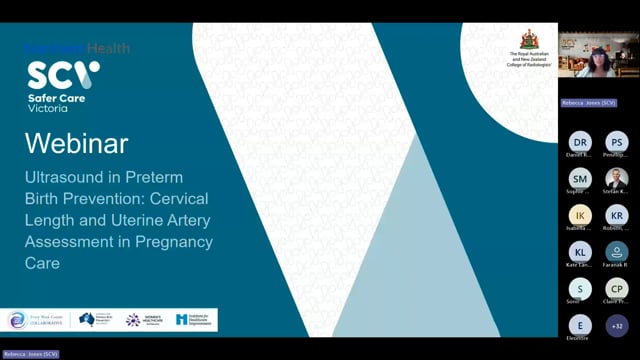
View more View lessUltrasound in Preterm Birth Prevention – Cervical Length and Uterine Artery Assessment in Pregnancy Care
December 2025
Ultrasound has a well-established role in optimising pregnancy outcomes for mothers and babies alike, with sonographers and radiologists playing a critical role in the provision of this care. Preterm birth (PTB) remains a leading cause of perinatal morbidity and mortality, and ultrasound makes a substantial contribution in reducing PTB rates, through:
- Identifying women at risk of PTB by measuring the cervical length on the mid-trimester morphology scan. Many women with a short cervix on this scan have no other risk factors for PTB and would otherwise have missed the opportunity for preventative therapies such as vaginal progesterone and cervical cerclage;
- Identifying women at risk of early-onset pre-eclampsia (a major cause of iatrogenic PTB) with assessment of resistance in the maternal uterine arteries at the time of the nuchal scan, as part of combined first-trimester screening for pre-eclampsia.
This webinar will focus on the evidence, indications, techniques and practice tips for these sonographic evaluations, which are increasingly considered to be the standard of care in Australia.