

Share your birth and care preferences
You may wish to start thinking about your preferences for birth and care. Think about what matters most to you and share this with your maternity care provider.
You can always:
- discuss your preferences with your maternity care provider
- ask for your preferences to be recorded in your clinical notes
- keep a copy of your antenatal record
- ask for an updated copy at each appointment.
Things to consider and discuss with your maternity care provider
Knowing all your options is important to guide informed decision making but it is also important to note that individual circumstances may affect the available options.
Where and how you give birth
Consider and discuss with your maternity care provider how you want to give birth and what might help you feel calm, safe and supported during labour.
Care during labour and birth
A birth plan can help you to be clear about your care preference including any language or communication needs, cultural, spiritual or personal needs.
Pain relief and comfort
Consider the benefits and risks of the pain relief available to you during labour. Discuss how you feel about pain relief options and the ways you plan to manage the pain or discomfort of labour.
Your support person
Consider who you would like with you during labour and birth, what you might do if someone shows up unexpectedly and how your plans align with the policies of your intended place of birth. Your maternity care team can help manage these situations but it is important you and your partner or support person are aware of your plans and expectations.
Maternity care plan
A birth plan can help you to be clear about your care preference, including any language or communication needs, cultural, spiritual or personal needs.
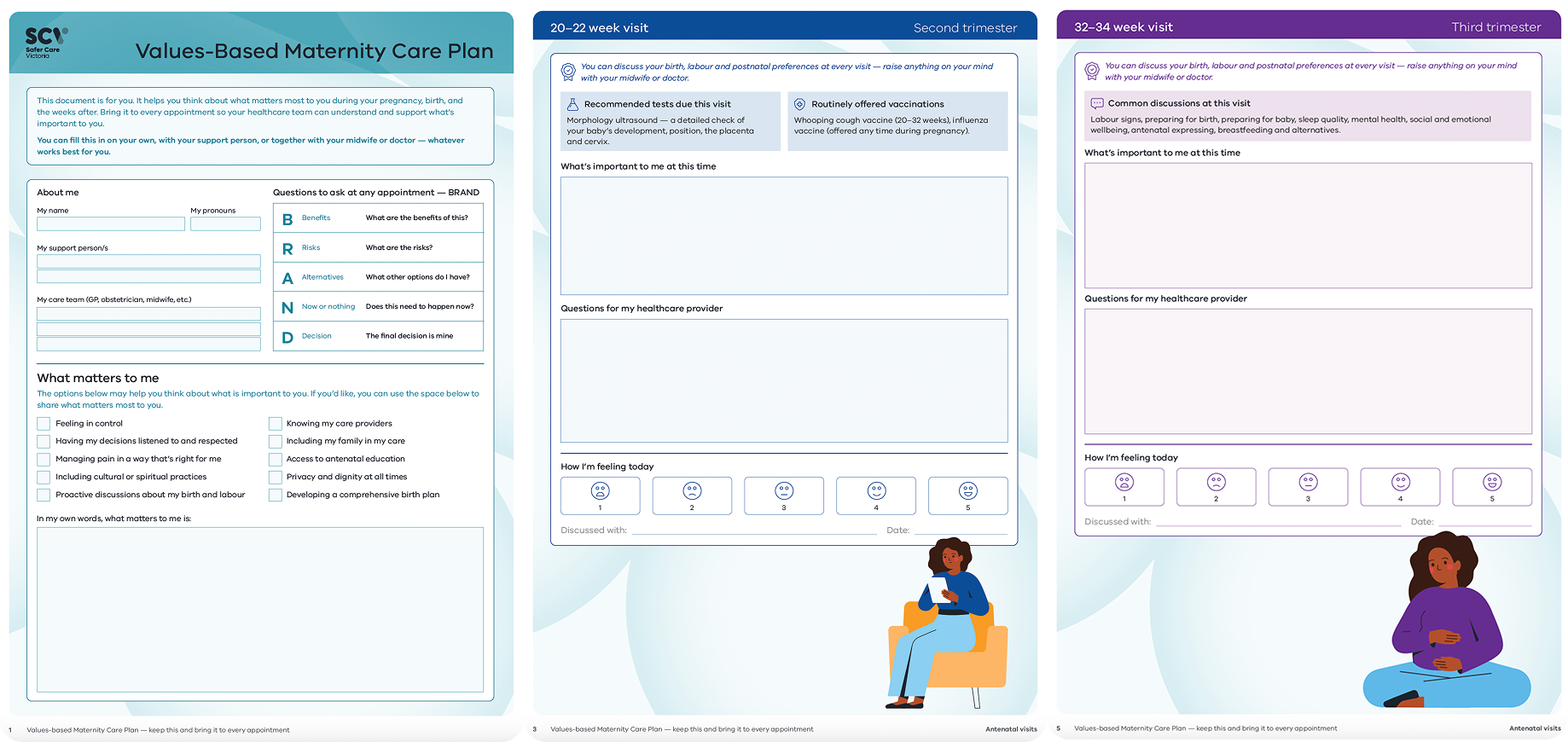
Our Values-Based Maternity Care Plan helps you think about what matters most to you during your pregnancy, birth, and the weeks after. You can fill this in on your own, with your support person, or together with your midwife or doctor.
Values-Based Maternity Care Plan | Safer Care Victoria
Remember
Your preferences can change as your pregnancy progresses. Sharing what matters to you helps your maternity care providers support you in the best way possible. Having alternative plans in place can help if things don’t go as expected.
Understand what is normal and when to get help
Learning about early signs of labour and when to seek advice or urgent care.
It helps to know:
- The signs of labour, such as:
- regular tightening or contractions that get stronger and closer together
- lower back pain or cramping – like period pain
- your waters may or may not break. If they do break it can be a gush, trickle or unexplained wetness
- You may have a “show” any time in the two weeks before labour starts, or not at all. Your show is usually jelly-like and the amount may vary.
- When to contact your maternity care provider, including:
- when you think labour has started
- if your waters break
- if you have pain, vaginal bleeding, changes to baby movements or concerns about your health or your baby if your maternity care provider has given you individualised advice about when to call.
Be aware that labour can sometimes start earlier than expected. Contact your maternity care provider straight away if you think this may be happening or if something does not feel right.
Know where to go and who to contact
It is important to understand when to call your maternity care provider, where to go when labour starts and what to do if plans need to change.
Plan for when labour starts
You should think about how you will travel to your planned place of birth when labour begins and what to do in the event of heavy traffic or roadworks.
Considerable costs apply for being transported in an ambulance if you don’t have an Ambulance Victoria Membership or a healthcare card. People seeking asylum are eligible for free emergency ambulance transport. Your private health insurer may cover some of the costs but you should refer to your individual policy for full coverage information.
If you are having a home birth and you think labour has started, contact your private midwife. They can help you assess what is happening and work with you to develop a plan that reflects your needs, preferences and circumstances as labour progresses
It is important to:
- practice driving to your planned birthplace and be familiar with parking costs and restrictions
- plan alternative routes in case of traffic, roadworks or other delays
- have a back-up transport plan
- know how to access your place of birth at any time, including after hours (this may not be through the main entrance).
If you live far from your planned place of birth or labour progresses quickly:
- ask your maternity care provider about maternity services in your area, in case you can’t make it to your planned place of birth in time
- if plans change, it is always safer to go to a maternity hospital, even if it is not your booked hospital
- staff can help decide whether it is safe to continue travelling, if you should stay or arrange an ambulance transfer.
You will also need to:
- arrange care for other children, dependants or pets at home.
- plan for time away from home - ensure you pack what you will need such as phone chargers, Medicare Card, photo ID or insurance card.
- discuss with your maternity care provider the expected length of stay.
Planning ahead for the care of older children can help reduce stress if you need to stay in hospital as most maternity wards are unable to provide supervision for siblings while a mother is admitted as an inpatient.
Know when to call your maternity care provider
Know when to call your maternity care provider or back up hospital, including:
- when labour starts
- if you have concerns about your health or your baby’s movements
- if something does not feel right.
Save important phone numbers in your phone, such as:
- your maternity care provider (midwife, doctor or maternity assessment unit)
- the hospital or birth centre where you plan to give birth
- the hospital switchboard or maternity ward
- a support person or trusted contact
- Triple Zero (000) for emergencies.
Get ready for birth
Expressing colostrum during pregnancy
Colostrum is the first milk your body makes for your baby from second trimester, in preparation for your baby’s birth. A little goes a long way. Colostrum is packed with everything a newborn baby needs in the days after birth.
Colostrum is best collected by hand expressing, colostrum is produced in very small amounts and is thicker than mature breastmilk. Your maternity care provider can suggest suitable containers to collect and store the colostrum.
The Australian Breastfeeding Association recommends discussing antenatal expressing with your maternity care provider before starting. Most women will start antenatal expressing from 36 weeks. It is particularly beneficial for mothers with diabetes, if you’re anticipating feeding difficulties or for babies who may be separated from their mother at birth.
Expressed colostrum should be collected into sterile syringes or containers labelled with your name, the date and time of expression and stored in the freezer until required. Frozen colostrum can be transported to the intended place of birth, usually in a cooler with ice pack. Discuss specific instructions with your maternity care provider.
Being unable to express enough colostrum to store is not an indication you won't be able to produce milk after your baby is born.
Learn more
Expressing colostrum before baby is born | Australian Breastfeeding Association
Expressing breastmilk during pregnancy— reasons for, when and how | Pregnancy Birth and Baby
Storing expressed breastmilk | Australian Breastfeeding Association
What to pack in your hospital bag
As you get closer to your due date, pack a hospital bag for yourself and your baby. This is important because labour can start suddenly or unexpectedly and having your bag ready can help you feel calm and prepared.
You can ask your maternity service what they provide for you, as supplies vary between hospitals.
Learn more
Packing for hospital | Better Health Channel
Emotional support and visitors
Thinking ahead about support can help you feel more comfortable. Check ahead of time the visitor's policy at your maternity service regarding number and timing of visitors. Visiting restrictions may also vary between birth suite and the maternity ward, or your mode of birth. You may wish to:
- decide who you want to support you during birth and immediately after
- talk with family and friends about visiting and what feels right for you and your family
- make sure your support person and maternity care provider know your visiting preferences so they can help make sure your boundaries are respected
- be aware of the parking restrictions or costs for parking during your stay.
Prepare your home for your new baby
Before your baby comes home:
- make sure you have an installed infant car seat or capsule, that meets Australian standards, to transport them home
- have essential baby items ready and washed
- set up a safe sleeping space.
For more information about preparing to bring your baby home and the child restraint requirements in Victoria, visit:
Child Car Restraint Laws | Kidsafe VIC
Child car seats and restraints | Transport Victoria
How To Create A Safe Nursery | Red Nose Australia
Safe Sleep And Safer Pregnancy Advice Hub | Red Nose Australia