
About the CGMM
The Clinical Governance Maturity Matrix (CGMM) provides health services with a structured approach to assess organisational clinical governance and plan improvements with confidence.
It provides a practical pathway for building capability, fostering accountability and driving continuous improvement across the health system.
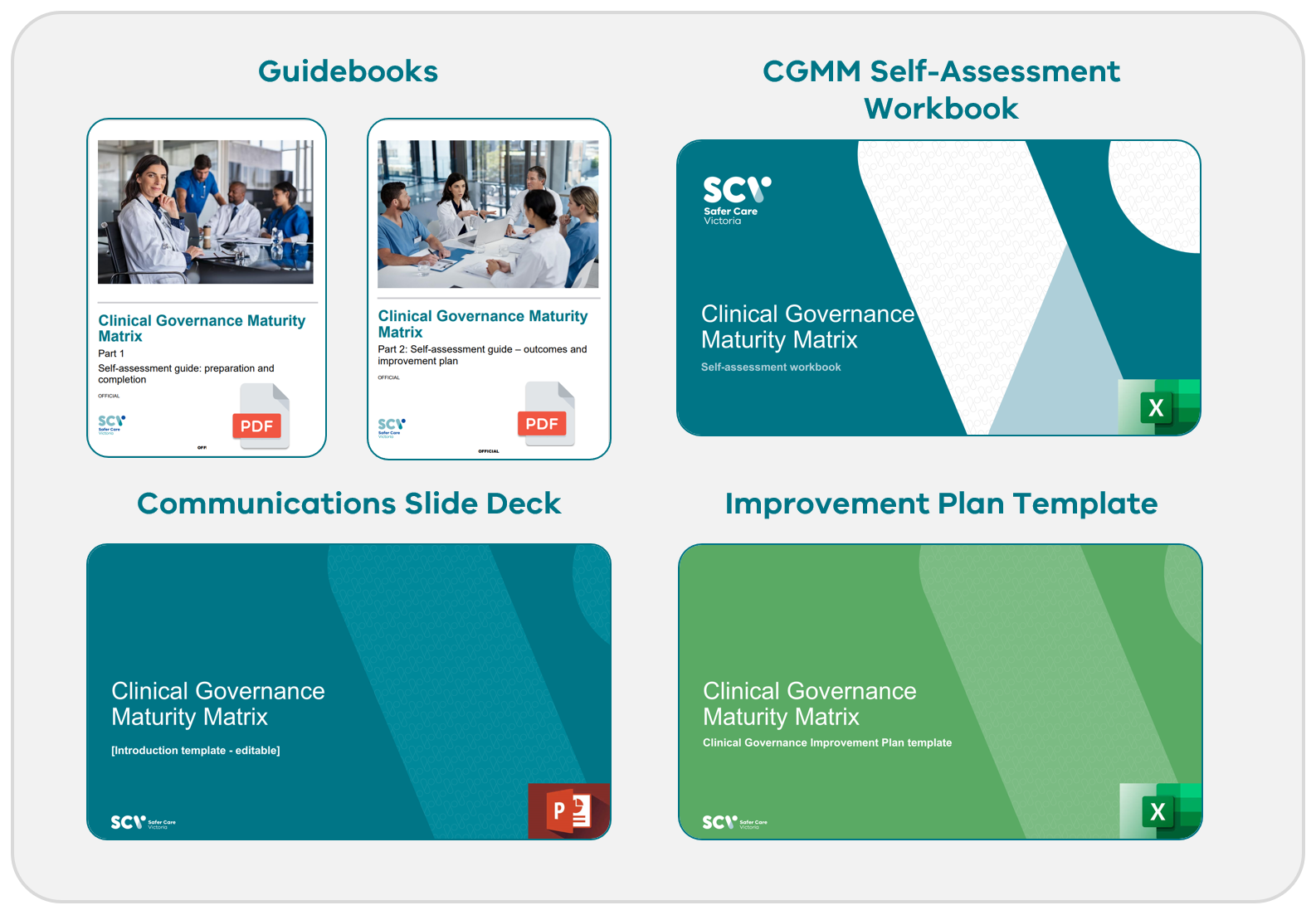
This comprehensive self-assessment matrix is supported by practical resources and tools to guide implementation, planning, and continuous improvement.
Download the CGMM
Clinical Governance Maturity Matrix – Self-assessment workbook
What is a maturity matrix?
View more View lessA maturity matrix is a structured assessment tool used by organisations to evaluate how well-developed their systems, practices, or capabilities are in a specific area. It helps measure current performance, set improvement goals, and track progress over time. This encourages continuous improvement and strategic planning.
Why self-assessment matters
View more View lessUnderstanding your organisation’s clinical governance performance is a vital step toward meaningful and sustained improvement. Regular assessment and monitoring over time enable health services to:
- identify areas of strength and opportunities for development
- track progress and maturity across key governance domains
- support a culture of accountability, safety, and continuous learning.
How this benefits health services
View more View lessUsing the CGMM enables health services to:
- facilitate meaningful dialogue, insights and reflection across all levels of the organisation
- use automated visuals to capture and present clinical governance maturity
- identify strengths and areas for improvement in clinical governance
- set priority focus areas and tangible targets to guide future progress
- develop a targeted clinical governance improvement plan
- communicate findings, share insights and learnings.
How to complete the self-assessment
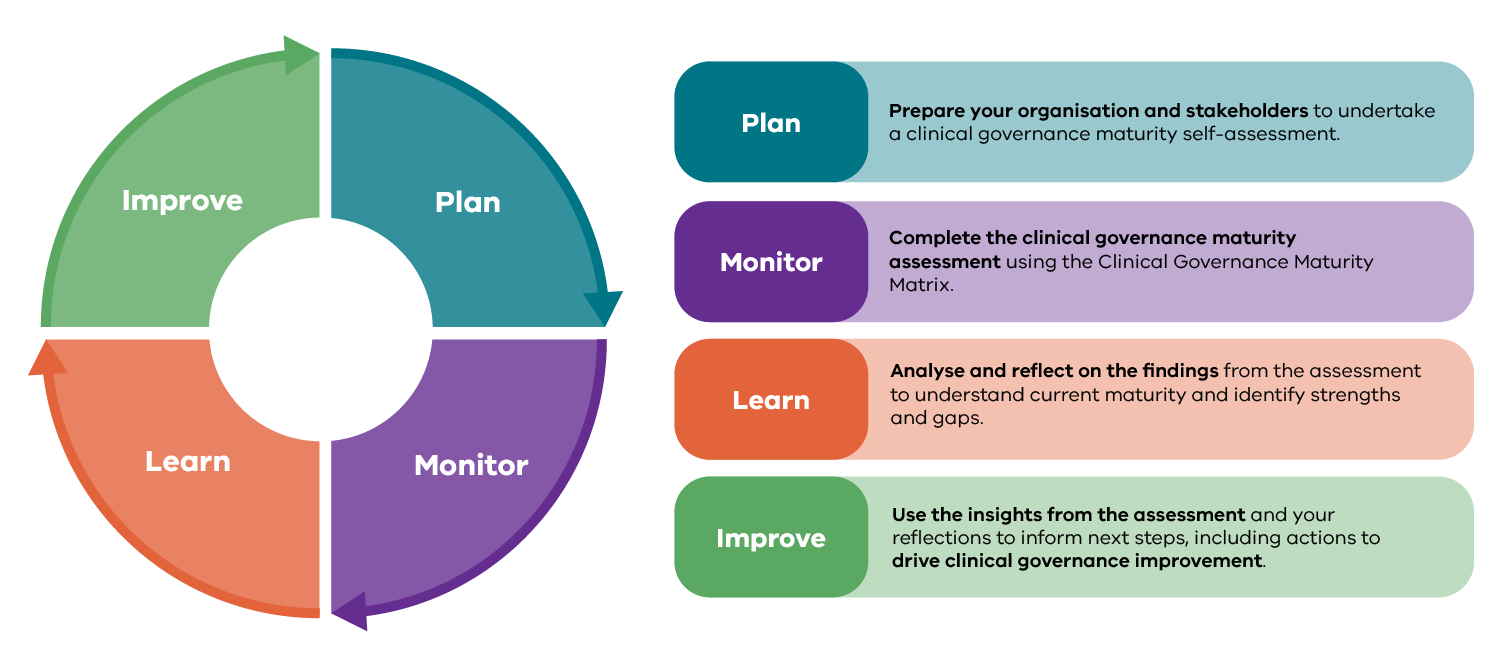
The self-assessment cycle follows four key stages: Plan, Monitor, Learn and Improve.
This self-assessment process should be revisited at least annually to:
- monitor progress towards service level clinical governance maturity goals
- reflect on changes and emerging priorities
- adjust improvement plans based on evolving needs and insights.
1. Plan
View more View lessPrepare your organisation and stakeholders to undertake a clinical governance maturity self-assessment.
Self-assessment guide – Part 1 – Preparation and completion
This guide introduces the CGMM and outlines practical steps for planning and conducting the self-assessment.
Slide deck
Use our slide deck to support communications in your health service.
Fact sheet
This fact sheet provides key information about the Clinical Governance Maturity Matrix (CGMM).
2. Monitor
View more View lessComplete the clinical governance maturity assessment using the Clinical Governance Maturity Matrix.
Workbook instructions
Read the step-by-step instructions for navigating the workbook, completing the assessment, reviewing results, and planning improvements.
Clinical Governance Maturity Matrix – Self-assessment workbook
Use the self-assessment workbook to complete the maturity assessment. This workbook provides tabs with auto generated visual results.
3. Learn
View more View lessAnalyse and reflect on the findings from the assessment to understand current maturity and identify strengths and gaps.
Self-assessment guide – Part 2 – Outcomes and improvement plan
Use this guide to interpret results from the maturity assessment, identify improvement priorities and develop targeted actions.
4. Improve
View more View lessUse the insights from the assessment and your reflections to inform next steps, including actions to drive clinical governance improvement.
Self-assessment workbook – "Improvement Plan Template"
Use the tab “Improvement Plan Template” in the Clinical Governance Maturity Matrix to document and plan key improvement activities, responsibilities, and timelines for each improvement goal.
Frequently asked questions
View more View lessIs the CGMM mandatory?
No, use of the CGMM to assess clinical governance maturity is not mandatory. It is designed to support reflection, celebrate progress, and guide clinical governance improvement planning.
The CGMM and Local Health Service Networks
As part of the LHSN Statement of Expectations, health services within each network are required to assess their clinical governance maturity. The Clinical Governance Maturity Matrix (CGMM) offers one approach to conducting a maturity assessment; its use is optional and not mandated for health services.
How long does it take to complete the CGMM?
Timeframes will vary depending on the chosen approach to complete the assessment, as well as the size, complexity, and context of the health service. Health services may choose to conduct the assessment through focus groups, surveys, or other methods that best meet their needs.
Health services have flexibility in how they undertake the clinical governance maturity assessment using the CGMM. This may include completing one domain at a time—perhaps starting with a priority clinical governance domain or an area where known improvement is required.
LHSNs may provide guidance to health services within their network on preferred approaches for CGMM administration and follow-up.
How is the CGMM structured?
The CGMM is organised into domains and elements aligned with the Victorian Clinical Governance Framework, with maturity levels ranging from foundational to advanced. This enables health services to begin their assessment with an individual domain.
Who will keep the CGMM data?
Health services will be the owners and managers of the CGMM assessment data, SCV will not be collecting the data.
Who should complete the CGMM?
The CGMM may be applied wherever clinical governance is in place. The CGMM is intended for health service leadership teams, governance committees, and other stakeholders involved in clinical governance. It can also be used to engage staff across different levels. Ideally, a cross-section of staff including executives, managers, clinicians, and governance leads should participate in the assessment, and improvement planning to ensure diverse perspectives.
How should results be used?
Results should inform conversations about clinical governance strengths, gaps, and priorities, and guide the development of an action plan for continuous improvement.
What if our organisation scores low in some areas?
This is expected and provides valuable insight. The CGMM is about learning and improvement, not compliance or comparison. Low maturity, or lower than expected maturity highlights opportunities for focused improvement.
What is the difference between the CGMM and the SCV Clinical Governance Health Check?
The Clinical Governance Maturity Matrix is an organisational self-assessment and improvement tool designed to support health services to systematically evaluate clinical governance maturity, highlighting strengths and areas for improvement. Participation is sought from a broad range of organisational stakeholders, including executive leaders, clinical governance directors, quality and safety teams, senior clinicians, consumer representatives, and workforce and culture leads.
The Clinical Governance Health Check is designed for health service leaders, including boards and executive teams. This tool supports health service leaders to reflect on their clinical governance practices and identify opportunities to refine and strengthen co-leadership alignment in clinical governance
Importantly, one self-assessment tool does not replace the other, each serving a specific function in reviewing and strengthening clinical governance.
How will SCV collect feedback on the CGMM?
SCV is committed to working with sector partners to optimise the CGMM. Over the first 6–12 months, we will collect data to understand the tool’s impact and usability, with a strong commitment to refining and improving it to best meet the needs of Victorian health services.
Feedback will be gathered through multiple channels to ensure the tool remains practical and effective, including surveys, focus groups, consultation, direct feedback channels (email) and data analysis.
Supporting resources
Glossary and reference list – Clinical Governance Maturity Matrix
Plan Monitor Learn Improve checklist – Clinical Governance Maturity Matrix
Contact and support
For questions, feedback or further support, please contact culture.capability@safercare.vic.gov.au.