
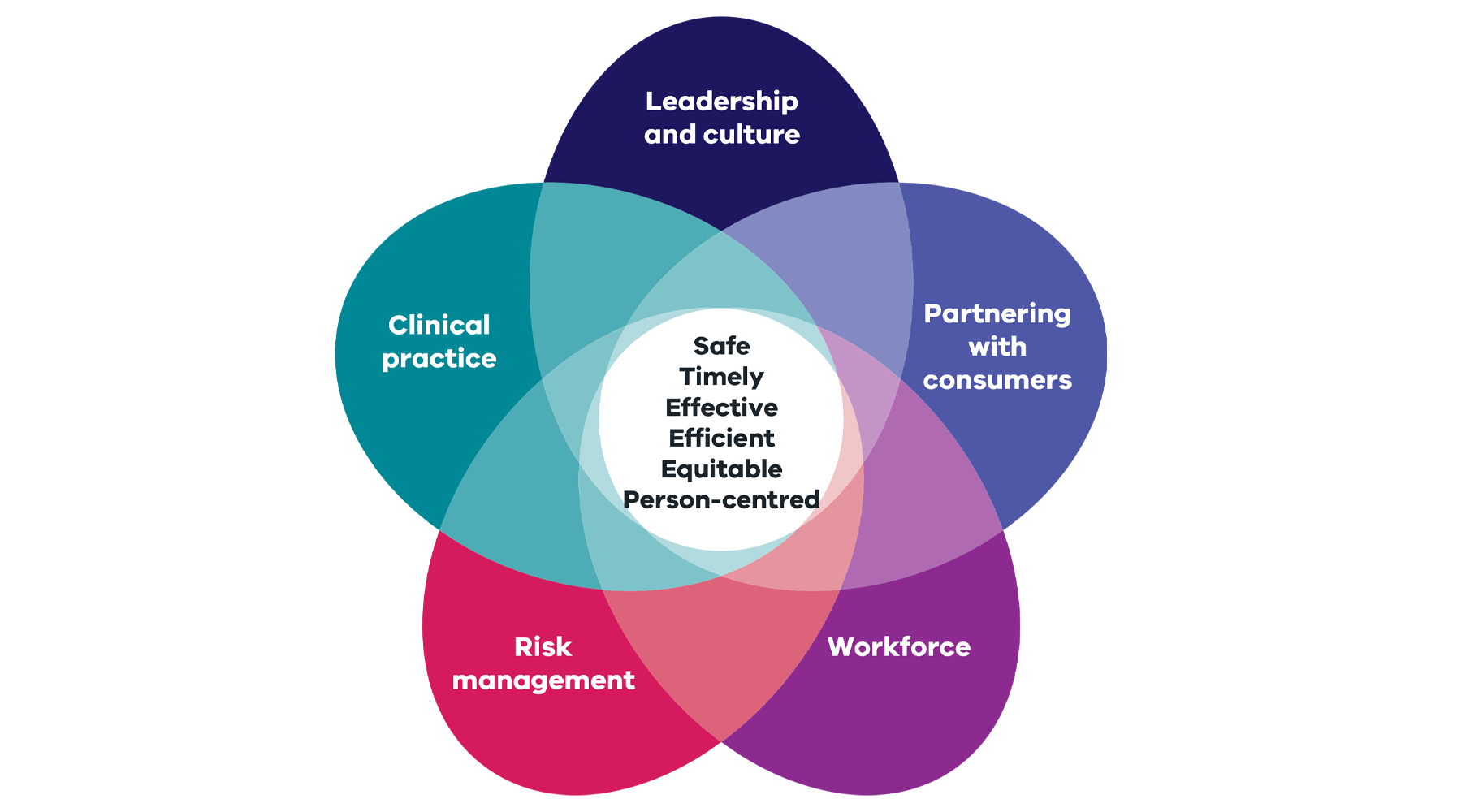
These resources aid understanding, implementation and monitoring of the five domains within the Victorian Clinical Governance Framework:
- Leadership and culture
- Partnering with consumers
- Workforce
- Risk management
- Clinical practice.
Leadership and culture
View more View lessUse these resources to create a strong organisational culture and cultivate it through effective and visible leadership. They’ll support you to achieve high-quality care by fostering an inclusive and safe environment where employees and leaders collaborate and speak up for safety, and where consumers and employees actively participate in service planning and delivering services.
Victorian Safety Culture Guide
Provides actionable strategies for health service Boards, CEOs and Executives to measure and monitor an organisation's safety culture, utilising available methods within the health services.
Clinical Governance Maturity Matrix
An organisational self-assessment tool designed to support Victorian health services to systematically evaluate clinical governance maturity, highlighting strengths and areas for improvement. The clinical governance maturity assessment invites participation from a broad range of organisational stakeholders, including executive leaders, clinical governance directors, quality and safety teams, senior clinicians, consumer representatives, and workforce and culture leads.
Clinical Governance Leadership Health Check
This self-assessment tool helps health service boards and executives assess and improve their clinical governance leadership and mindset by highlighting areas of alignment and opportunities for improvement.
Quality improvement toolkit
Fact sheets, tools and resources to help you improve the quality of care in Victoria.
Directors' toolkit
A resource to assist board directors and other interested parties to understand their role and responsibilities and the operating environment of the public sector health service.
Medical director role resources for rural and regional health services
These resources include role and responsibilities, an engagement model, and are designed to assist rural and regional chief executive officers and medical directors working in the Victorian public hospital system.
Strengthening governance in public sector residential aged care services (PSRACS)
This readiness tool helps Victorian PSRACS boards and executives analyse their organisational clinical governance systems and how they apply to the residential aged care services.
Communities - targeted health care and services to key population groups
It is important for all services to consider how they can become more inclusive of Victoria's diverse communities, comprised of many groups with varied health characteristics and requirements for care.
Foundations of Clinical Governance for Boards and Executives
We run the Foundations of Clinical Governance sessions targeted at building clinical governance capability for boards, CEOs and executives of Victorian health services.
Directors' conduct and workplace culture
Find practical examples of what compliance with the Directors' Code of Conduct looks like, as well as mechanisms for boards to manage issues of board member behaviour should they arise.
Information and education for health service boards
Training and skills workshops for board members are held annually across Victoria. Resource links are available.
Partnering with consumers
View more View lessUse these resources to elevate and incorporate the consumer voice at all levels to ensure good clinical governance. Discover ways to build strong relationships with consumers to create better care plans and treatments, improve care outcomes and experiences, and provide high-quality care.
Partnering in healthcare framework
Find practical strategies to improve healthcare and outcomes for Victorians by better involving consumers and their families, with supplementary assessment tools.
Involving impacted consumers – Adverse events
Resources developed in partnership with health services and consumers and aligned with the Statutory duty of candour that support reviews of serious adverse patient safety events.
Mental health lived experience resources
People with lived experience are central to the planning, design and delivery of mental health and wellbeing services.
Workforce
View more View lessExplore the following to create a physically and psychologically safe workplace to help staff perform at their best. Evidence shows that a skilled, competent, and engaged workforce leads to high-quality care outcomes for consumers.
Victorian Safety Culture Guide
Find actionable strategies for health service boards, CEOs and executives to measure and monitor an organisation's safety culture, utilising available methods within the health services.
Developing employee centred rostering principles
Workforce availability is a key challenge to the delivery of safe efficient and effective care to the Victorian community. Rostering is a critical element of job satisfaction and workforce availability, and it requires dynamic evolution to meet the needs of the future.
Credentialing and scope of clinical practice for senior medical practitioners policy
This policy details Victorian requirements for senior medical practitioner credentialing and scope of clinical practice.
Worker health and wellbeing in Victorian health services
Guidance for health services to ensure that the right systems are in place to address occupational health and safety concerns.
Our workforce, our future
A framework for Victoria's mental health and wellbeing workforce.
Risk management
View more View lessFind out how to integrate risk management and prevention for clinical governance with organisational governance. Explore why it’s important to employ both proactive and reactive measures to reduce adverse events and effectively address errors.
Morbidity and Mortality meetings - Framework and toolkit
This framework provides health services with a structured, systems-based approach to the Morbidity & Mortality case reviews and discussions in Victoria.
Managing adverse events
Provides guidance and resources for individual, health service and SCV responsibilities when responding to an adverse patient safety event.
Statutory Duty of Candour and protections for SAPSE reviews
Resources on Statutory Duty of Candour (SDC) requirements and review and reporting processes following a serious adverse patient safety event (SAPSE).
Victorian Health Services Performance Data
Explore quality and safety performance data for Victoria's public health services and hospitals.
Clinical practice
View more View lessEmpower clinicians to deliver high-quality care with resources that will support systems, processes, and organisational culture that are underpinned by evidence-based, best practice care, and an environment of continuous improvement. Use our tools to achieve better outcomes and elevate your care standards.
Victorian Quality and Safety Capability Framework
This framework outlines the essential knowledge, skills, and attributes required for individuals in the Victorian healthcare system to deliver consistently high-quality care, work to prevent avoidable harm and foster learning and improvement.
Quality Improvement Toolkit
Fact sheets, tools and resources to help Victorian Health Services improve the quality of care.
Victorian Health Incident Management System (VHIMS)
A guide to the standardised dataset for the collection and classification of clinical, occupational health and safety (OH&S) incidents, near misses and hazards.
HOSdata – Victorian hospital data reports
Links to key information data sets such as admitted episodes, emergency presentations and elective surgery waitlist information.
Contact and support
For questions, feedback or further support, please contact culture.capability@safercare.vic.gov.au.