
Change concept
Connect families to community asthma support after discharge
Most asthma care happens in the community, not in hospital. Linking families to appropriate services after discharge reinforces education, improves medication adherence, and reduces the risk of re-presentation.
While some regions have dedicated Community Asthma Programs (CAPs), all health services can support families by referring them to statewide options.
Statewide programs
Local programs
- CoHealth Community Asthma Program
- DPV Health Community Asthma Program
- Western Health Community Asthma Program.
Change ideas
These strategies ensure families leave the hospital with a community asthma program referral to ensure families can be contacted and an appointment can be made after discharge.
Include referral prompts in discharge processes
- Add community referral steps to discharge checklists and workflows.
- Use EMR prompts to remind staff to complete referrals before discharge.
Educate staff on available services
- Provide clear guidance on referral pathways for CAPs and statewide services.
- Share quick-reference resources during onboarding and team huddles.
Make referrals easy for families
- Give families printed or digital information about community asthma support.
- Use QR codes or links to direct families to online education and support tools.
- Encourage clinicians to explain the benefits of community follow-up during discharge conversations.
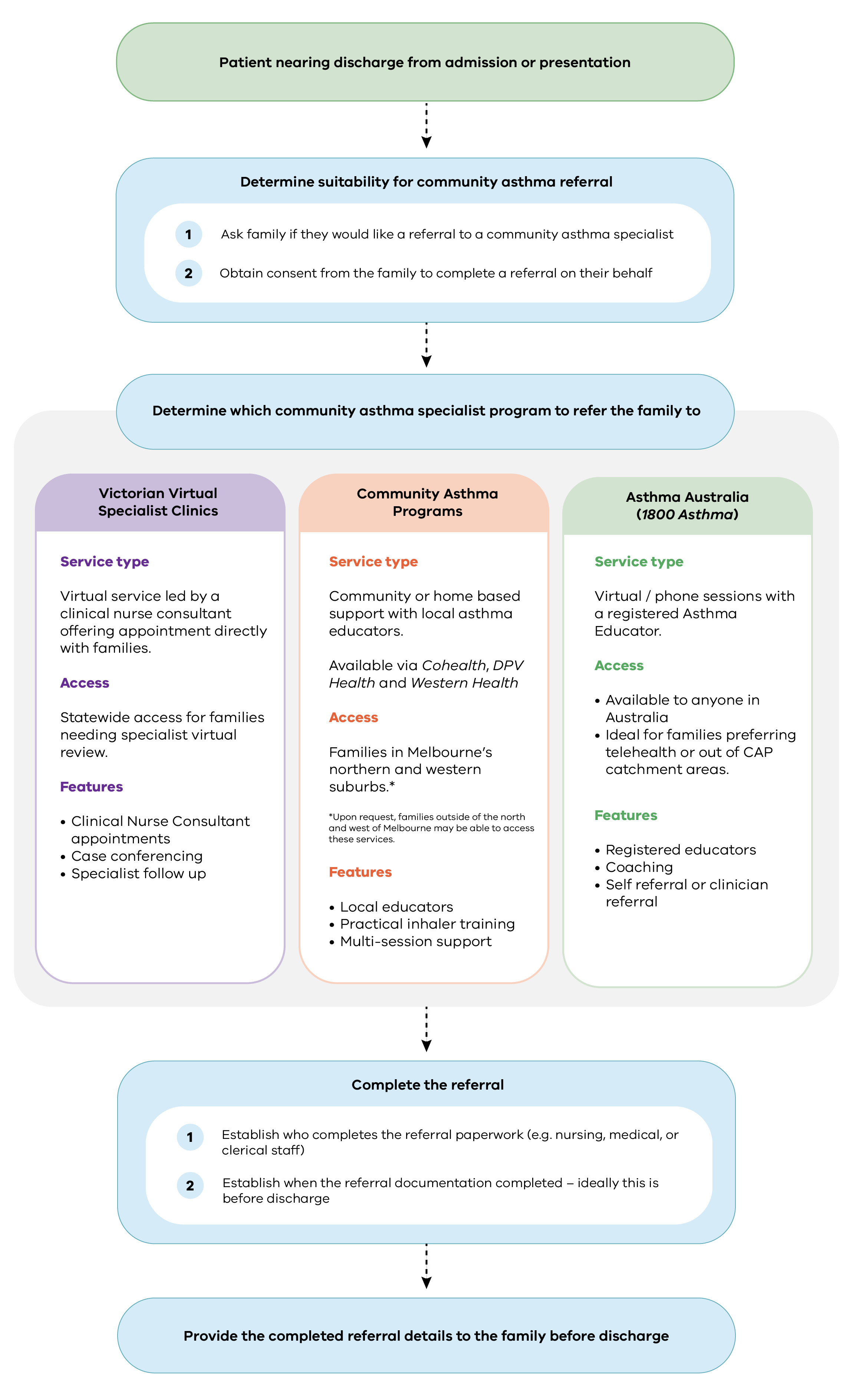
Referral process example
Making referrals to community asthma specialist programs
Measuring this change
Health services should measure whether referrals to a community asthma program are being made at discharge. This supports continuity of care and ongoing asthma management after hospital presentation or admission.
Whether testing is increasing referral rates can be assessed by reviewing medical records for children who attend the emergency department or are admitted for asthma care. Clear documentation that a referral was made should be counted as a positive outcome.
What to do
- Establish a baseline by reviewing recent asthma discharges.
- Regularly sample ED or ward records to check whether a referral was documented.
- Track results over time to assess whether changes are improving practice.
Optional: Where feasible, follow up with families (e.g. survey or phone call) to understand whether referrals led to attendance. This may be better suited to consumer feedback or experience surveys.
What to measure
Numerator: Eligible children referred to a community asthma specialist before discharge.
Denominator: Eligible children who attended ED or admitted to ward for asthma management.
Lessons from applying MAGIC in practice
Barriers and enablers
Common barriers included:
- no consistent process for initiating referrals in acute settings
- nursing teams lacking the authority or training to complete referrals
- time pressures and competing priorities in ED environments.
Common enablers included:
- automatic referral prompts for medical teams and MAGIC-based discharge checklists
- upskilling nursing staff to complete referrals independently.
- weekly follow-up calls from community programs to maintain engagement.
- co-designing referral pathways and resources with health services for practicality and scalability.
Case study
An emergency department tested ways to increase referrals to community asthma programs. Initially, referrals were inconsistent and mostly limited to patients discharged from the ED Short Stay Unit. Children discharged from other areas were often missed.
To achieve this, they:
- developed a CAP referral resource outlining the EMR process
- streamlined referrals to a central intake team, removing postcode-based barriers
- delivered education sessions for medical and nursing staff
- added visual prompts and reminders to discharge workflows
- embedded referral checks into daily huddles and onboarding communications.
This resulted in:
- increased referral rates and reduced missed opportunities
- improved staff awareness and confidence in referral processes
- a model that can be adapted for statewide services like Asthma Australia and the Virtual Asthma Clinic.
Lessons learned
- Referral processes must be simple, centralised, and easy to access in EMR systems.
- Education and onboarding for rotating staff are critical for sustainability.
- Children discharged from all areas should be considered for referral.
- Nursing staff play a key role and should be empowered to confirm referrals.
- Centralised intake models reduce complexity and support scalability.
- Visual prompts and standardised resources improve consistency and compliance.