
Change concept
Provide asthma medications or a script in-hand before discharge
Asthma preventer medication should only be prescribed when a child meets the criteria set out in recognised medication guidelines. When indicated, preventer medication is a critical component of effective ongoing asthma management.
Children who leave hospital or the emergency department without guideline‑appropriate preventer medication or a prescription in hand, are at increased risk of poor asthma control and re‑presentation to hospital.
Health services should ensure that preventer prescribing decisions are made in accordance with medication guidelines, and that children and families leave hospital with either the appropriate preventer medication or, at a minimum, a script/eScript when criteria are met.
The Royal Children’s Hospital (RCH) asthma medication guideline should be used to determine whether a child meets the criteria for preventer medication. Use of this guideline should be embedded within routine medication prescribing and discharge processes.
To ensure families can start and continue preventer treatment after discharge, it is important to plan for common challenges that may affect access, understanding and ongoing use. Key barriers and improvement actions include:
Unfilled prescriptions: Many medications prescribed are never dispensed after discharge.
Improvement action: Enable children to leave hospital with preventer medication in hand this can be supported by early prescribing and pharmacy involvement in discharge planning.
Poor medication adherence: Families often struggle to use preventer medications consistently and correctly.
Improvement action: Build in teach‑back education and hands‑on inhaler technique training before discharge, and support families to establish a daily routine for preventer use.
Low health literacy: Limited understanding of asthma care reduces the likelihood of filling and using prescriptions as intended.
Improvement action: Use clear, plain‑language explanations, visual resources and culturally appropriate education to explain what preventer medication is, why daily use matters, and how it helps keep children well at home.

Change ideas
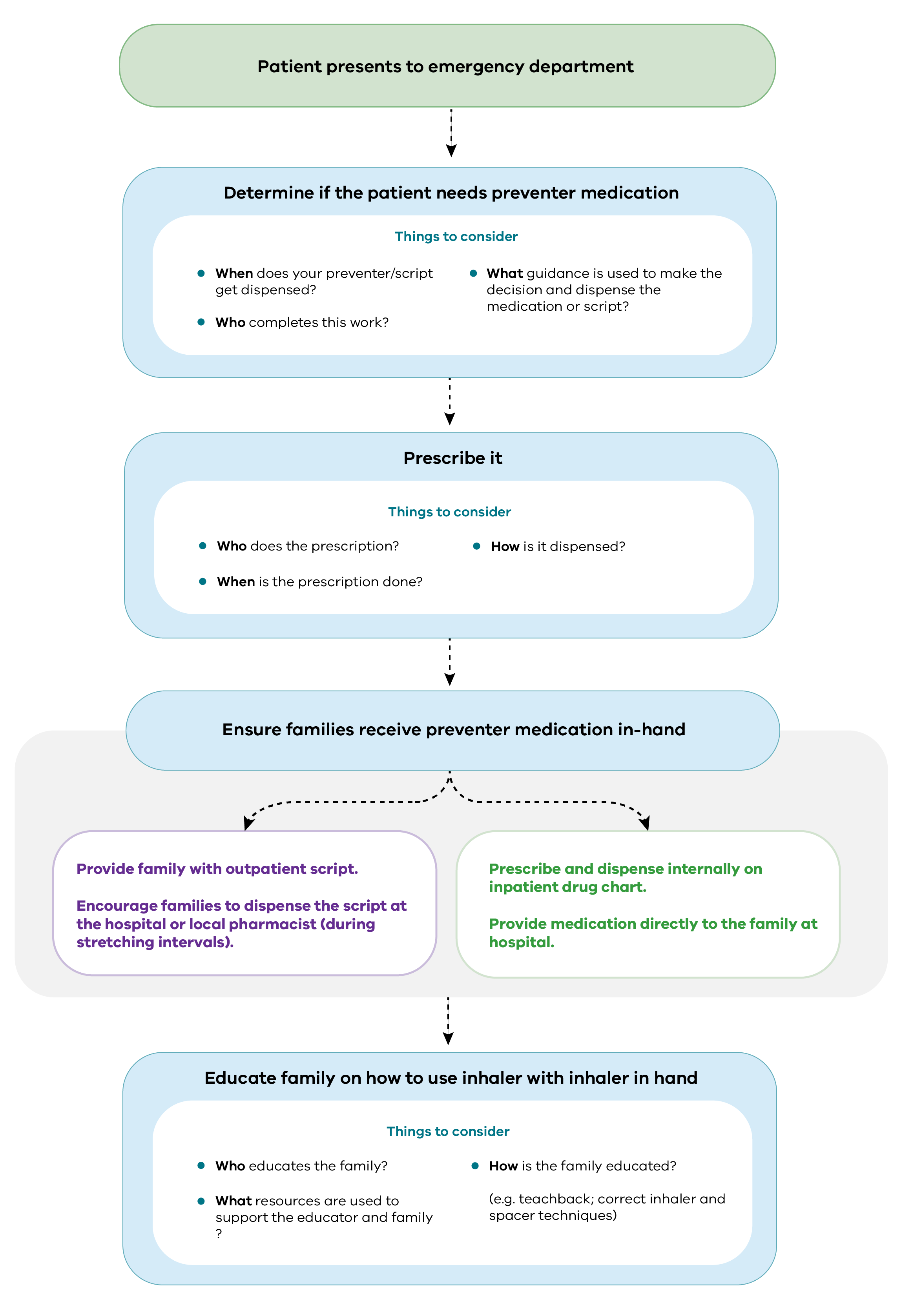
Develop a process for dispensing medication or script in-hand at discharge
Create a clear process for providing either the medication or a prescription to families before they leave hospital. Where possible, embed this process into routine asthma care.
When developing this process:
- map your current workflow to identify issues and opportunities using our process mapping tool
- establish clear steps for prescribing, pharmacy coordination and family education
- assign roles and responsibilities for each step in the process
- document and share the process to all staff involved in discharge planning.
Example process for dispensing medication or script in-hand at discharge
Partner with pharmacy to embed medication provision into discharge planning
Work closely with your pharmacy team to ensure:
- asthma medications (especially preventers) are stocked and available for dispensing before discharge
- pharmacy staff are involved early in the patient journey
- local guidelines for medication provision are regularly reviewed and updated
- other staff are educated on medication options and supply processes.
Test early script completion to allow time for pharmacy coordination
Asthma preventer medications are often prescribed at discharge, which can delay departure and increases the risk that children leave without medication or a script in hand.
Prescribing earlier in the patient journey allows pharmacy teams time to prepare medications and supports a smoother, timelier discharge once the child is clinically ready.
To test this change in your service:
- Trial writing preventer prescriptions earlier in the admission, rather than waiting until discharge
- Reinforce the importance of early prescribing during handovers and shift changes
- Start small and refine the process using Plan-Do-Study-Act (PDSA) cycles before scaling
- Watch for common barriers such as:
- after-hours pharmacy access
- staff hesitancy to prescribe without consultant input
- families wanting to leave quickly.
Add medication / script provision into discharge checklists
Families often leave hospital without the right asthma medication or a prescription. Making this step part of your discharge checklist ensures it’s never missed.
To support this change:
- use prompts or electronic medical record (EMR) pop-ups to remind staff to complete this step
- regularly audit discharge checklists to monitor compliance and identify areas for improvement
- co-design checklists with frontline staff and families to ensure they are practical and user-friendly.
Measuring this change
To understand whether these changes are being implemented as intended, services can review whether children and families leave hospital with an asthma preventer, or a script/eScript, when indicated.
Reviewing medical records for children presenting with asthma allows services to see whether testing is increasing preventer or script provision. Documented evidence that a preventer or script was provided indicates a measure of success.
What to do
- Establish your baseline data by reviewing recent asthma discharges.
- Identify how often children left with a preventer or script/eScript.
- Conduct a regular (ideally weekly) review of a small sample of ED or ward asthma presentations to check whether a preventer or script was provided.
- Track results over time (for example, using a simple run chart) to see whether your tests are leading to improvement.
What to measure
Numerator: Children leaving with a preventer or script/e-script in hand (when appropriate).
Denominator: Children who present to ED or admitted to ward for asthma management.
Lessons from applying MAGIC in practice
Barriers and enablers
Common barriers included:
- limited preventer stock in emergency departments
- additional costs to families and services
- prescribing uncertainty among junior doctors
- after-hours pharmacy access
- families prioritising quick discharge.
Common enablers included:
- prescribing early in admission
- MAGIC checklist prompts
- pharmacy involvement in discharge planning
- prescriber education and EMR pop-ups
- strong GP partnerships
- visual prompts and QR codes.
Case study
A paediatric ward tested a new approach to prescribing asthma preventer medications earlier in the patient journey. The goal was to ensure children meeting the criteria for preventer therapy left hospital with either the medication in hand or a script ready to be filled.
To achieve this, they:
- ran education sessions for medical and nursing staff
- shared communications from senior clinicians
- distributed preventer medication guides to support decision-making
- published newsletters encouraging early dispensing before discharge.
Lessons learned
Within this paediatric ward, the initiative improved:
- collaboration between pharmacy, nursing, and medical teams
- the visibility of asthma care priorities across the ward
- awareness and prescribing of Flixotide, which was more readily available and easier to use than alternatives.
However, several challenges emerged:
- junior doctors were hesitant without consultant input
- after-hours pharmacy access was limited
- families often wanted to leave quickly
- staff turnover and medical rotations affected consistency.
To address these issues, the team reinforced communication through regular updates and embedded prompts into the electronic medical record to make the process sustainable.